
Why That “Great Deal” Badge Might Not Be So Great
This post is part of our “Shop Smarter” series, helping consumers navigate today’s car market with confidence.
If you’ve shopped for a car online recently, you’ve probably seen them: bright green badges that say “Great Deal” or “Good Deal” next to certain vehicles on sites like CarGurus. They’re designed to help you quickly spot a bargain. And the concept is genuinely useful.
But here’s what those badges don’t tell you — and what could cost you thousands of dollars if you’re not careful.
How Deal Ratings Actually Work
CarGurus is the most visited automotive shopping site in the United States, with roughly 39 million monthly visitors. Its signature feature is the Instant Market Value, or IMV — an algorithm that estimates a vehicle’s fair retail price by comparing it against similar vehicles currently listed and recently sold in your area. The system factors in make, model, year, trim, mileage, and geographic market data.
Once it calculates the IMV, the algorithm compares each vehicle’s listed price against that benchmark and assigns a rating:
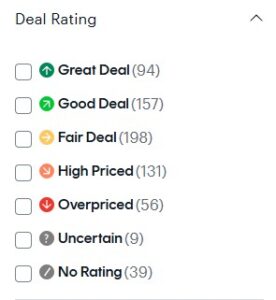
- Great Deal — priced significantly below the estimated market average
- Good Deal — priced moderately below market
- Fair Price — priced at or near market average
- High Price / Overpriced — priced above market average
On the surface, it seems straightforward. And for many listings, the ratings do provide helpful directional guidance. T
he problem isn’t the concept. It’s what the algorithm can’t see.
The Blind Spot: What the Algorithm Misses
The deal rating is based entirely on the listed price — the number a dealer enters into the system. And that’s where things start to break down.
Conditional pricing. Some dealers list vehicles at an artificially low “sale price” with a disclaimer buried in the fine print: “price assumes 30% down payment” or “price reflects $2,500 trade-in credit.” The algorithm can’t read those asterisks. It sees a low number, compares it to the market, and stamps it with a “Great Deal” badge — even though the actual price is thousands more than what’s displayed.
Baked-in rebates. Other dealers build manufacturer rebates or federal tax credits directly into the listed price — even when not every buyer qualifies. One consumer reported finding a Chevrolet Silverado EV listed at $64,384, only to discover at the dealership that the price had $10,500 in credits pre-applied. The real price was nearly $75,000.
Hidden fees. The algorithm evaluates the listed sale price, but it doesn’t factor in dealer conveyance fees, which in Connecticut alone can range from under $500 to well over $1,000. A vehicle that appears to be a “Great Deal” at one dealership may actually cost more out the door than a “High Price” listing at a dealer with a lower fee.
Vehicle condition. The algorithm has no way to assess maintenance history, accident damage, or mechanical issues. Two identical vehicles with the same price can receive the same deal badge even if one has been meticulously maintained and the other has deferred service and undisclosed problems.
Factory options and accessories. This may be the biggest blind spot of all — and one that almost no one talks about. The algorithm compares vehicles by year, make, model, trim, mileage, and location. What it can’t see are the individual options and accessories that can make two “identical” vehicles dramatically different in value.
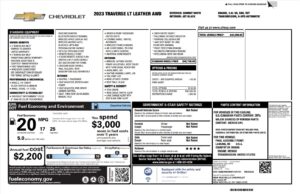
2023 Chevrolet Traverse AWD LT with basic content
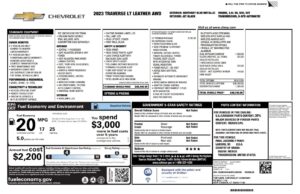
2023 Chevrolet Traverse AWD LT with Leather plus the LT Premium Package
Here’s a real-world example. Take a 2023 Chevrolet Traverse AWD LT with leather interior. A basic version of that vehicle had an original MSRP of $43,990. But another Traverse with the exact same year, model, and trim that included the LT Premium Package — adding HD Surround Vision, Bose premium audio, Adaptive Cruise Control, Enhanced Automatic Emergency Braking, an infotainment system with navigation, Rearview Camera Mirror, heated outside mirrors, a 120-volt power outlet, 20-inch alloy wheels, and more — plus a Dual Skyscape Sunroof, had an original MSRP of $49,745. That’s a difference of nearly $6,000 in factory equipment.
As far as the CarGurus algorithm is concerned, these two vehicles are the same. They’ll be grouped together in the same comparison set. So the fully loaded Traverse — the one with nearly $6,000 more in features — might receive a “Fair Price” or even “High Price” rating, while the base version earns a “Great Deal” badge. A consumer who shops by badge alone could easily pass over the vehicle that actually represents the superior value.
An educated buyer looks beyond the badge. Maintenance history, Carfax accident and ownership data, original factory equipment, overall condition, dealership reputation, and dealer fees all factor into whether a vehicle is truly a good deal. The rating is just the surface.
How This Hurts Honest Dealers — and You
Here’s the part that frustrates us — and should concern you as a consumer.
When dealers game the system with conditional pricing, they don’t just inflate their own ratings. They skew the entire dataset. The algorithm uses all listed prices to calculate its market average. When artificially low prices flood the system, the calculated “market average” drops — which means dealerships listing their honest, no-asterisk price get penalized with “High Price” or “Overpriced” labels.
The irony is painful: the dealer who is transparent about pricing looks more expensive than the dealer who is hiding the real cost in the fine print.
At Karl Chevrolet, our listed price is our real price. No conditions, no assumed down payments, no rebates you may not qualify for. When we say a vehicle is priced at $34,927, that’s what it costs — plus tax, registration, and our $489 conveyance fee, which is one of the lowest in Connecticut. We don’t play pricing games, and we won’t start — even if it means our deal badges don’t always look as shiny as a competitor who’s bending the rules.
There’s another dimension worth mentioning. Located in affluent Fairfield County, Connecticut, Karl Chevrolet’s pre-owned inventory features mostly very highly contented vehicles — many of them one-owner, meticulously maintained, and equipped with premium packages and options that don’t show up in a deal badge. When you combine that vehicle quality with our pricing transparency and one of the lowest fee structures in the state, the overall value stands apart — whether an algorithm recognizes it or not.
What You Can Do to Protect Yourself
Deal rating tools aren’t useless — they just shouldn’t be the final word. Here’s how to use them wisely:
1. Always ask for the out-the-door price. Before you drive to a dealership — or even before you get excited about a listing — call or email and ask: “What is the total price I will pay, including all fees, with no conditions?” Get it in writing. If a dealer won’t provide this, that tells you something.
2. Read the fine print on every listing. Look for disclaimers about assumed down payments, required trade-ins, or rebate qualifications. On CarGurus, these are sometimes hidden behind an additional click at the bottom of the listing. If you see an asterisk anywhere near the price, dig deeper.
3. Compare the conveyance fee. Ask every dealer you’re considering: “What is your dealer conveyance fee?” Connecticut law requires this fee to be disclosed. The difference between dealers can be $500 or more — real money that never shows up in a deal badge.
4. Cross-reference with independent sources. Use Kelley Blue Book or JD Power to get an independent market value estimate. If a dealer’s listed price is dramatically below what KBB says the vehicle is worth, ask yourself why. It may be a genuinely great deal — or it may be a price that comes with strings attached.
5. Look at the whole picture. A deal badge is one data point. Also consider the dealer’s reputation, their history of fair dealing, whether a vehicle history report is included, and how they treated customers when times were tough — like during the pandemic. These factors don’t show up in an algorithm, but they make all the difference in your actual experience.
The Bottom Line
Online deal ratings can be a helpful starting point in your car search. But they were never designed to be the whole story — and unfortunately, some dealers have found ways to make them misleading.
At Karl Chevrolet, we believe the best deals are built on transparency, not algorithms. We price every vehicle against Kelley Blue Book and JD Power benchmarks, we keep our conveyance fee at $489, and we never attach conditions to our listed prices. We’d rather earn your trust with honesty than earn a badge with fine print.
The next time you see a “Great Deal” badge, take a moment before you click. Ask the right questions. Read the fine print. And compare what you’ll actually pay — not just what a rating says you should feel.
Next in the series: The Fee Most Car Shoppers Never Think to Compare — a deep dive into Connecticut’s dealer conveyance fees, how they vary, and why this hidden cost matters more than you think.
Read the full series: SHOP SMARTER SERIES